

Oh, these funny cats with short legs – you can admire them forever 🐱.
These furry dwarf cats come in all shapes and sizes. They can have long fur, short fur, or even no fur at all!
Short legged cats are a relatively new type of breed that have short legs (or other features) due to their genetic mutation.
These cats are short in stature, but they are not exactly miniature animals.
Cats with short legs are considered a rare breed and have been gaining popularity since the last century. Some of these breeds are also quite charismatic and interesting.
Let’s learn more about these cute cats with small legs.
Table for Content
- History of cat breeds with short legs
- What can cause short legs in cats?
- Cats with short legs – Infographics
- Munchkin
- Bambino
- Dwelf
- Minskin
- Kinkalow
- Lambkin
- Skookum
- Minuet
Cats with Short Legs – the Whole Article in One Video
A Little History of Cat Breeds With Short Legs
The first reports about short-legged cats include observations of feral animals in England in the 1930s. And in 1931, scientists had already described a hereditary disease associated with short legs.

In 1944, a dynasty of short-legged cats was documented in England. In a veterinary journal, Dr. H. E. Williams-Jones mentioned the existence of 4 generations of cats with short legs.
The doctor also observed an 8.5-year-old black short-legged cat who was perfectly normal. Her feline relatives, her mother, grandmother, and some of her offspring, were similar.
In the 1956 book “Zoologischer Anzeiger” the author Max Egon Thiel from Hamburg, Germany, described a cat he saw in Stalingrad in 1953. The cat had unusually short legs and played amusingly with its kindred.
He saw the cat sitting on its hind legs as if its front paws were in the air. That is why he named it “Stalingrad Kangaroo Cat.” A Russian doctor picked the cat up the day before he returned to Germany. Nothing else was known about her.

Short-legged mutations appeared further. Some affect all 4 limbs, while others affect only the front limbs.
This Mexican stray Pedro, photographed in 1993, has hind legs of normal length. However, his front paws are shortened, thickened, and appear slightly twisted.
When the Munchkin breed was recognized by the International Cat Association (TICA) in 1995, there was much controversy. Critics expressed concern about potential health and mobility problems in such cats.
Many breeding cat associations around the world have refused to recognize Munchkins because of serious health problems (according to the Universities Federation for Animal Welfare, UK).
What Can Cause Short Legs in Cats?
So far, it is impossible to say with certainty which of several possible mutations the “kangaroo cats” actually had. Kangaroos, if you remember, also have short legs.
So, such short paws in animals are often associated with the term “micromelia“. Micromelia implies a certain form of abnormality in the development of small limbs. It is likely that such cats had one of the many forms of dwarfism that occur in mammals.

A common and easily recognized disease of short limbs is achondroplasia (dwarfism).
In this disease, the long bones of the limbs are shortened, although the trunk (body) and head remain unchanged.
Achondroplasia dwarfism is characterized by abnormal body proportions. It is caused by a dominant gene affecting the hormones that control bone growth.
In Munchkins, these short limbs are a distinctive feature of the breed. The other deformities associated with achondroplasia, however, can be avoided (as far as possible) by careful selective breeding.
Breeding individuals with spine or chest deformities should be avoided.
Achondroplasia is often associated with a large or abnormal head. However, Munchkins do not have this trait, indicating another condition that mimics achondroplasia – pseudoachondroplasia.
Cats with Short Legs – Infographics

1.Munchkin

The Munchkin is a fairly new breed of cat, which was recognized by the International Cat Association (TICA) in 1995.
- Origin — USA.
- The nature of the origin — mutation.
- Lifespan — 12 to 14 years.
- Size — from small to medium.
- Weight — females: 1.8 to 3.6 kg, males – from 2.7 to 4 kg.
- Height — from 18 to 20 cm.
- Coat — long-haired and short-haired with a semi-long silky coat.
- Conversational skills — medium.
- Care pattern — once a week.
- Requirement for attention — is high.
- The level of activity — is high.
Munchkin appearance
The munchkin has an average height and long body, triangular ears, and walnut-shaped eyes. And naturally, munchkins are distinguished by their short paws, which are recognizable characteristics.
It is the Munchkins that are the brightest representatives of all cat breeds with small legs.
And this breed is found in both long-haired and short-haired varieties.

Because they have a low stance, munchkins are good at maneuvering. They run and climb without difficulty. Contrary to many preconceived notions, munchkins can jump.
Naturally, the munchkins’ short legs will not allow them to traverse great heights, but they will not be inferior to the same Persian cat.
Because of their resemblance to dachshunds and corgis, Munchkins were originally considered at risk for back and joint problems. Many people were against breeding this breed because they thought they could not run and jump properly.
It should be noted that breed standards require that their legs do not point outward.
Munchkin coat and color
They usually come in long-haired or short-haired, silky, or plush coats. In addition to this, the colors can consist of different color patterns and combinations thereof.
Munchkin breed temperament
It is a typical sociable cat breed, quite agile and quicker than you might think. Friendly munchkins can play with other dogs and cats, as well as children.

These cats are often called “ferret-like” because they play, chase and run around with toys like ferrets.
And, to sit, they may adopt the “rabbit” pose.
Most munchkins like to sit upright. They are also described as magpie (or crow) birds – they often steal and hide toys and trinkets in their hiding places.
Munchkin health
It is known that, like other common cats, munchkins can be prone to some diseases.
Lymphosarcoma
It is a common type of cancer that occurs in lymphocytes. Lymphocytes are an important factor in maintaining a healthy immune system; they are integral to a cat’s overall health.
Specifically, lymphoma causes about 33% and 90% of all tumors and blood cancers in cats, respectively.
Feline lower urinary tract disease (FLUTD)
It is a disease of the lower urinary tract that is accompanied by hematuria (blood in the urine), dysuria (painful urination), and impaired urination. Cats suffering from FLUTD experience pain and difficulty urinating. This is especially true in cats.
In general, FLUTD can occur at any age. However, it is usually observed in overweight middle-aged animals and those with an improper diet.
Interesting facts about the munchkin cats
- These cats are called Munchkins, supposedly after the cats from The Wizard of Oz.
- In 1991, the munchkin cat became a household name when it was introduced on a television show.
- Liliput is the world’s smallest cat of the munchkin breed. She was about 13 cm tall – entered into the Guinness Book of World Records in 2014.
- As a rule, munchkins come in a variety of colors, patterns, and shades.
- Well, who doesn’t know the board game of the same name?
Munchkins in the genes of other short-legged breeds
The Munchkin was the basis for a number of other short-legged cat breeds, including:
- Genetta — Munchkin and Bengal
- Bambino — Munchkin and Sphynx
- Minskin — Munchkin, Sphynx, Burma, Devon Rex
- Minuet — Munchkin and Persian
- Kinkalow — Munchkin and American Curl
- Lambkin — Munchkin and Selkirk Rex
- Skookum — Munchkin and LaPerm
- Scottish Kilt — Munchkin and Scottish Fold


Cat Body Temperature: Which is High or Low? When is It a Problem?

The Protein Revolution: 5 Game-Changing Points to Consider on Your Pet’s Feeding Package

Top 15 Longest Living Cat Breeds (with Pictures and Infographics)
2.Bambino

The breed is a hybrid of the Sphynx and the Munchkin. The very name of the breed in Italian means “child” and alludes to the mischievous temperament of the Bambino.
These are amazing cats on short legs, which clearly will not leave you indifferent.
- Origin — USA.
- The nature of the origin — crossbreeding.
- Lifespan — 12+ years.
- Size — from small to medium.
- Weight — 2.3 to 4 kg.
- Height — from 18 to 20 cm.
- Coat — fluffy down / bald.
- Conversational skills — medium.
- Care pattern — medium.
- Requirement for attention — medium.
- The level of activity — high.
Bambino appearance
Bambinos are the result of a recent successful crossbreeding. They are cats with wedge-shaped heads, wide-set eyes, and short square muzzles.
Bambino cats are a muscular breed with a medium skeleton. The coat varies from almost hairless to peach fuzz. All colors and patterns are allowed by the standards.

It is known that the very short paws of bambinos are genetically borrowed from munchkins. But they inherited their hairless fur with white or pink skin from sphinxes.
It should be noted that there are variants of long-legged bambinos.
An additional feature of these cats is rather large ears.
Bambino coat and color
Very often these cats look like newborn babies – many of them are completely bald. Even if they do have some fur, it looks fluffy and very light.
Although they appear to be bald, bambinos are mostly covered in thin, short down.
Care of a Bambino
Frequent grooming is also recommended for the bambino to reduce or remove sebum.
In addition, weekly bathing is recommended. If bathing and grooming are not continued regularly, these cats can develop skin infections.
Bambino breed temperament
They are very affectionate, intelligent, and friendly. These cats love to be cuddled and picked up. The bambino gets along well with children and other pets.
In general, bambinos adapt very well to new environments.
Bambino health
The Bambino is a new breed. Therefore, more research is needed to confirm the absence or propensity for possible health problems.
Let’s break down the health problems that owners of this breed may encounter.
Health problems from sphynx cats
- heart disease;
- skin diseases due to clogging of the skin with oil;
- They are also prone to periodontal disease, which means that their teeth need regular care.
Health problems from munchkin cats
Shortened limbs are known to be directly inherited from munchkins. This genetic mutation is known as pseudoachondroplasia. Therefore, bambinos cannot run fast or jump as high as other cat breeds.
Consequently, there is a good chance that naked bambino cats can inherit all the diseases from their parents. So, when choosing a kitten, pay attention to the health of the momma cat and the daddy cat.
Interesting facts about Bambino
- Bambino kittens are born both long-legged and short-legged.
- In addition, these cat breeds produce fluffy and naked kittens.
- TICA recognizes the Bambino as a new experimental breed.
3.Dwelf

Dwelf cats are big-eared, short-necked, and bald cats descended from the Munchkin, American Curl, and Sphynx. These cats have rounded bellies and short, powerful paws.
Dwelfs are another representative of the short-legged cat breed.
This breed has a long thin tail, a long head, and protruding cheekbones. The front paws of dwelfs are usually curved.
Dwelfs have almond-shaped eyes and large floppy ears. They are also known for their stocky and small appearance.
- Origin — USA.
- The nature of the origin — crossbreeding.
- Lifespan — 8 to 12 years.
- Size — from small to medium.
- Weight — 1.8 to 3.2 kg.
- Height — from 15 to 18 cm.
- Coat — are bald; have very short hair; skin color sometimes black.
- Conversational skills — high.
- Care pattern — high.
- Requirement for attention — medium.
- The level of activity — medium.
Dwelf appearance
The dwelf’s hair varies from short, and fluffy to almost nonexistent. Eyebrows and sideburns can be very short or absent. These cats feel like suede and are also warm and soft.
A distinctive feature of dwelfs is wrinkles on the forehead, shoulders, and paws.
Quite often, these cats have dark markings on their bodies.
Care of a Dwelf
As medium to complex care cats, they require timely bathing to keep their skin supple, clean, and soft.
Like many breeds, dwelfs need a claw trim at least once every two weeks.
Dwelf breed temperament

Dwelf cats love their owners and easily adapt to people.
These cats with small feet are playful, active, friendly, and sociable. And believe me, having short legs does not prevent them from being good and faithful friends.
Despite their short legs, they will definitely find new ingenious ways to get into the closet or on your bed.
Dwelf health
Again, dwelfs are a fairly new breed and so far it is difficult to speak of any serious health problems.
At present, this cat breed seems to be healthy and robust.
However, it should be kept in mind that there may be genetic problems associated with this cat.
- Funnel-shaped chest deformity (Pectus Excavatum) is a deformity that results in a sunken chest and funnel-shaped chest.
- Lordosis in cats (curvature of the spine to the inside).
Interesting facts about dwelfs
- Dwelfs are a bald and curious breed, known for their dwarf bodies and elfish facial features.
- Like their bambino relatives, these cats remain similar to kittens even as adults.
- The name of the breed is actually a combination of his elfin features and dwarfism.
4.Minskin

Do you want a mini cat with short legs? Then get a Minskin.
This unique and very cute cat is quite a rare breed.
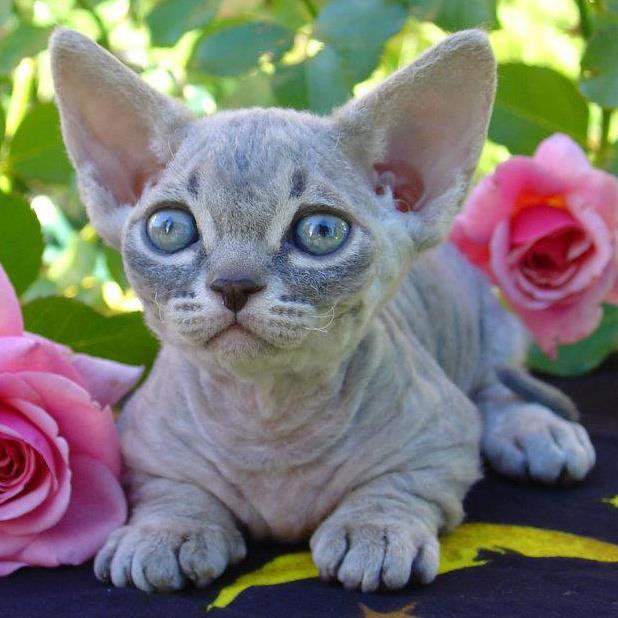
With big eyes and ears that look like aliens, Minskins look like a cat from another planet.
This breed was obtained by crossing the Munchkin with the Sphynx with some genes from the Devon Rex and Burma.
- Origin — USA.
- The nature of the origin — crossbreeding.
- Lifespan — 12 to 14 years.
- Size — small.
- Weight — 1.8 to 3.2 kg.
- Height — from 18 to 20 cm.
- Coat — rare hair of any pattern and color.
- Conversational skills — low.
- Care pattern — high.
- Requirement for attention — medium.
- The level of activity — medium.
Minskin appearance
These cats have very short legs. The fur appears only in certain places, including the face, ears, nose, legs, and tail.
Notably, the belly appears hairless, but only sparse hair appears along the rest of the body.
Moreover, if a minskin does have fur, it resembles the most delicate silk fabric.
These cats have semicircular, stocky bodies and large eyes with rounded heads.
Minskins can be striped or Siamese colored.
Minskin care
They require frequent bathing. This procedure is sure to prevent the accumulation of fat on the skin.
Minskins, like other naked cat breeds, require protection from the sun’s rays. But in winter you will have to buy such a cat a sweater – they may need clothes to keep warm.
Minskin breed temperament
They are very friendly, loving, and cuddly cats. Minskins are very affectionate animals who treat other pets well.
They are also very intelligent, fun, and friendly companions.
In general, these cats adapt easily to their new environment. In addition, they have a charming charm and can let you know their needs immediately.
Minskin health
These breeds are prone to the same health problems that most cats face.
The hairless skin of Minskins can develop yeast fungus (Malassezia pachydermatis). Accordingly, your pet’s skin should be monitored.
This breed may also have lordosis or funnel-shaped chest deformity. Minskins should always be vaccinated to prevent them from contracting fatal diseases.
Interesting facts about Minskins
- The Minskins have a unique connection to Boston, USA (their city of origin).
- These cats have quite sensitive coats.
- These cats are pretty equally trusting of everyone, both strangers and their own.
- The distinct appearance of Minskins makes them attractive to kidnappers.
- They generally like to cuddle with people.
5.Kinkalow

Kinkalow is a rather rare breed of cat, obtained by crossing the American Curl with the Munchkin.
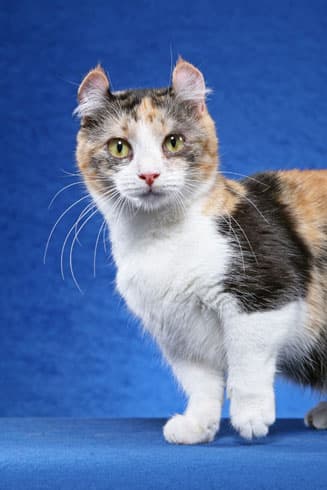
This short-legged cat breed inherited its small paws from the Munchkins, and its curly ears from the American Curl.
- Origin — USA.
- The nature of the origin — crossbreeding.
- Lifespan — 12 to 15 years.
- Size — small.
- Weight — 1.4 to 3.2 kg.
- Height — from 18 to 20 cm.
- Coat — from short to long.
- Conversational skills — medium.
- Care pattern — weekly.
- Requirement for attention — medium.
- The level of activity — medium to high.
Kinkalow appearance
Because of their munchkin parent, these cats are also a short breed.
An interesting fact is that newborn Kinkalow cats mostly have straight ears. However, later they curl up and take on a crescent shape.
Kinkalows have short or long coats that come in a variety of patterns and colors.
In general, Kinkalows have a slightly mystical and strange appearance precisely because of their twisted ears.
Kinkalow care
These cats require very little care. In fact, regular weekly grooming will be enough.
Kinkalow temperament
They behave quite actively, just like munchkins. At times, kinkalows behave like dogs – they will follow wherever their owners go.
It is unequivocal that these cats with small paws are full of energy, a little crazy, partly wild, and loving their owners.
Kinkalow health
In fact, these cats are quite sturdy and usually do not suffer from any health problems.
The main issue remains genetic heredity – pay attention to the pedigree when choosing a kitten.
Interesting facts about Kinkalow
- Keep in mind that not all cats have curly ears. Of course, they carry the gene, but they can also NOT pass it on to the next generation.
- In terms of behavior, these cats are curious and playful, but not hyperactive.
- They are considered an experimental breed of cat.
6.Lambkin

The Lambkin is a tiny, very gentle, and quite rare breed of cat. If you have seen at least one cat in your life, you can consider yourself lucky.
The Lambskin cat, also known as the Nanus Rex, is a cat that is still considered an experimental breed.
This may be the reason why the breed is not recognized by some cat associations.
This breed of cat with short legs is a cross between a Selkirk Rex and a Munchkin. It is noted that the Lambkin is a dwarf cat breed with a strong character.
The name “Lambkin” comes from their plush and curly hair. You can imagine a tiny cat in sheep’s clothing.
- Origin — USA.
- The nature of the origin — crossbreeding.
- Lifespan — 12 to 14 years.
- Size — small.
- Weight — 1.4 to 3.2 kg.
- Height — from 18 to 20 cm.
- Coat — long-haired, curly-haired, various colors.
- Conversational skills — medium.
- Care pattern — weekly.
- Requirement for attention — medium.
- The level of activity — medium.
Lambkin appearance
The long, curved, and fluffy tail, tapering to the tip, is another feature of this breed.
The Lambkin can be easily recognized by its short legs and long body, inherited from the Munchkin.
Lambkin care
It should be noted that Lambkin’s fur looks quite brittle. In addition, too much brushing can damage their coat.
Moreover, owners should make sure that the lambkin cat is bathed regularly to prevent heavy grease contamination.
In general, the level of grooming depends on the nature of their coat. But unequivocally, all Lambkins will require regular grooming.
Lambkin temperament

These cats have inherited the good-natured character of their ancestors.
Lamb cats love affection and physical contact with their owners.
In addition, breeders agree that despite their small size, this does not prevent them from jumping or being active.
Lambkin health
Again, there is some controversy as to whether or not Lambkin suffers from health problems.
Due to the lack of research, we would recommend contacting your veterinarian in the event of health problems.
Interesting facts about Lambkin
- Lambkins, which are considered one of the rarest breeds in the world, are also called Nanus Rex.
- This breed is officially recognized by the TDCA (Dwarf Cat Association) and TICA (International Cat Association).
- Cats of this breed really resemble a “young lamb,” justifying its name.
7.Skookum

Skookum (apparently meaning “sweet”) was bred in 1998 as a result of crossing munchkin with LaPerm.
It was previously known as LaMerm. These short-legged cats can be described in a few words – they are small, cute, and curly.
Although both the LaPerm and the Munchkin are recognized by TICA, the Skookum is still considered an experimental breed.
It should be noted that skunks are playful and are often described as born clowns.
- Origin — USA.
- The nature of the origin — crossbreeding.
- Lifespan — 10 to 15 years.
- Size — small.
- Weight — 2 to 4 kg.
- Height — from 17 to 20 cm.
- Coat — short to long.
- Conversational skills — medium.
- Care pattern — weekly.
- Requirement for attention — medium.
- The level of activity — medium to high.
Skookum appearance
Skookums, being a cross between Munchkins and Laperman cats, are easily recognized by their curly hair and short legs.
These cats have shorter bones than other breeds. They are also known for their stocky and short bodies. In addition, skookums have significantly shorter front paws than hind paws.
This breed has wedge-shaped heads, large, wide ears, and walnut-shaped eyes.
Skookum care
Taking care of these cats is quite simple.
Therefore, to keep your pet’s coat beautiful and stylish, it will be enough to brush it a couple of times a week.
Skookum temperament
Skookums are quite sweet and affectionate cats. In addition, this breed is playful, sociable, and curious. Indeed, Skookums are confident and like to climb and jump everywhere.
They love to be petted. In addition, their fur texture seems very pleasant and easy to care for.
Skookum health
Normally, Skookum does not suffer from any serious diseases. However, if you want to get a cat of this breed, make sure you get it from a reputable breeder.
Interesting facts about Skookum
- The name of the Scookum breed comes from the Native American language “Chinook,” which means “mighty,” “great,” and “strong.”
- They have a unique tail that tapers to the base and resembles a pompom.
- Skookums are not afraid of water 🛁.
- In countries such as Australia, this breed is considered a common show cat.
8.Minuet

Minuet (called Napoleon until 2015), was bred in 2002. It is a hybrid of the Munchkin and the Persian cat.
Of course, there are also long-haired Munchkins, but the Minuet combines features of both breeds.
- Origin — USA.
- The nature of the origin — crossbreeding.
- Lifespan — 9 to 15 years.
- Size — small.
- Weight — 2.5 to 4 kg.
- Height — from 18 to 20 cm.
- Coat — short to long.
- Conversational skills — medium.
- Care pattern — weekly.
- Requirement for attention — medium.
- The level of activity — medium to high.
Minuet appearance
This is not a short-legged Persian or a fluffy Munchkin. The minuet is a short-legged cat with a heavy-boned, round head, round eyes, and bright coat. Their coat can be either long (like a Persian) or short.
The pure minuet has about 75% Persian appearance and 25% Munchkin. As with other breeds derived from the Munchkins, there are also long-legged variants of the Minuet.
Minuet care
They need a medium level of care – it depends on the texture of your cat’s coat.
In fact, animals with longer hair need to be brushed twice a week, and for cats with shorter hair, once is enough.
Minuet temperament

These cats with small legs are suitable for anyone looking for a cute and compliant pet. Moreover, even families with small children will enjoy the company of this cat.
Minuets have a warm, friendly, and social demeanor. Also, these cats do not like to be left alone. They like human companionship.
In general, minuets are known for their gentle, friendly, and affectionate behavior.
Minuet health
You must make sure that the cat is acquired from a reputable breeder. In general, minuets can be susceptible to common diseases, including polycystic kidney disease.
Interesting facts about Minuet
- Until 2015, the breed was called the Napoleon. Yes, in honor of Napoleon Bonaparte, who was known to be short in stature.
- The breed is still not recognized by most felinological organizations.
Short-legged Cat Breeds – Summary
We hope you enjoyed our list of famous, and lesser-known, breeds of cats with short legs.
Definitely, these short-legged pets are sure to become your devoted friend and family member.
How can you not love such cuteness and cuteness? 👍
What do you think about short-legged cats? Ever thought about getting a kitten like that?
Murmeo link to the article: https://murmeo.com/en/cats-with-short-legs/


