
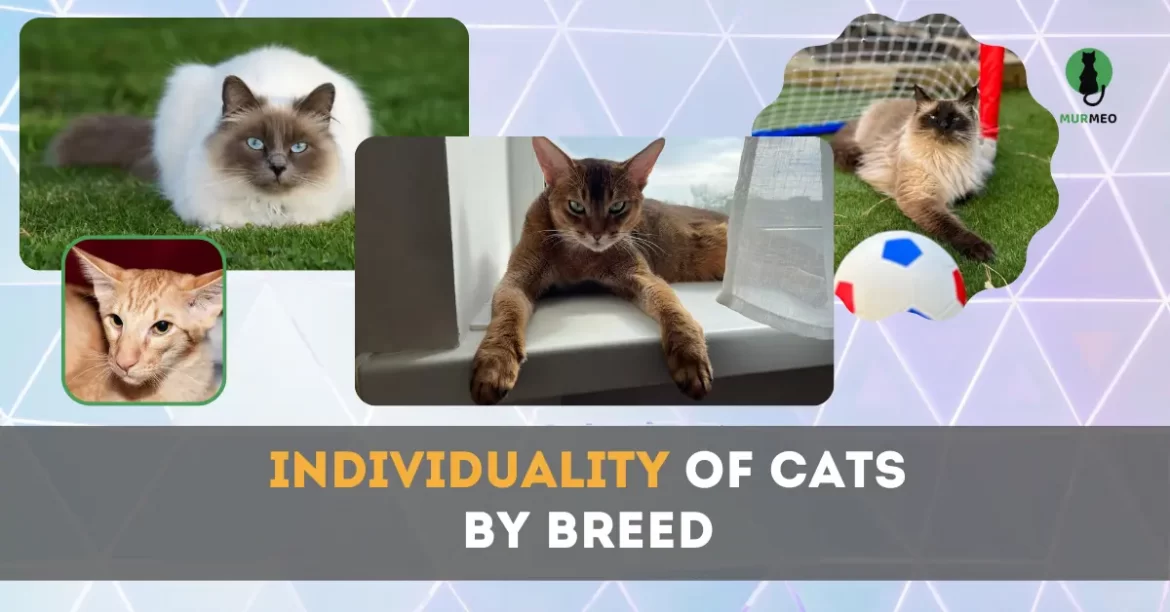
What is the bravest breed of cat? Which cats are the most fearful or the least friendly with people?
Surely you have asked yourself such questions, especially before you take a furry friend into the family.
Today we have a lot of interesting things about the characters and behavior of cats depending on breeds.
Cats are known to have their personalities. Like humans and other animals, there can be consistent differences in behavior between each animal and breed.
Identifying a cat’s personality type is important because cats with different personalities have different environmental needs to achieve a good quality of life.
For example, active cats may need more entertainment, such as playtime. Fearful cats may benefit from additional shelter and a quiet lifestyle from their owners.
Cats are popular pets, but their character is little studied.
But we came across a very interesting academic study from the Department of Veterinary Biological Sciences at the University of Helsinki, Finland, regarding the dependence of a cat’s character on their breed.
They studied cat character and behavior by collecting a huge dataset of over 4,300 cats using an online survey.
The study resulted in some correspondence between certain breeds of cats and seven specific feline behavioral traits:
- fearfulness,
- activity/playfulness,
- aggression to people,
- sociability (communication skills) with people,
- sociability with other cats,
- excessive grooming,
- litterbox issues.
And so – what breeds of cats have these or those traits of behavior and character?
We ourselves were eager to find out, as we are the owners of three wonderful pets.
But first things first…
And first, check out our entertaining infographic on the character of different breeds of cats.
Cat Characteristics by Breed – Infographic

What is Known About the Personality and Character of Cats?

A cat’s personality is an interindividual difference in behavior that remains stable over time and across contexts.
Their personality is influenced by genetics, environment, and their interactions.
Personality differences between individuals have been found in several species, including domestic cats.
It is important to note that knowing a cat’s personality type can be used to improve its well-being.
For example, fearful cats should get additional shelters in the form of houses, beds, and other things. In fact, everything is simple here – such animals will feel safe.
In addition, owners are certain to be more satisfied with their pets if their pet’s personality matches their own.
And even more than that, it has been proven that a cat’s temperament can also affect its suitability for families with children. Think of these instances of advertisements: “I’ll give a cat in good hands to a family with no children or other pets.”
And we are very sad when these situations happen.
The personality of cats has been studied by various methods
In some studies, veterinarians ranked cat breeds based on their professional experience observing, handling, and treating cats of different breeds in the clinic.
Other researchers used behavioral assessments or observations from cat guardians in shelters or laboratory colonies or conducted behavioral tests.
Finally, many studies have used questionnaires completed by owners. In these studies, owners are asked to rate their cat’s behavior in various situations or with a set of adjectives.
We will not list the most important studies in this article, but we will come back to them a little later. Subscribe and follow the news from our portal.
How Was Our Research on Feline Behavior and Cat Personalities Conducted?
Survey
The University of Helsinki developed a special questionnaire on cat behavior and personality, which contained 138 questions.
The questionnaire included three sections: behavior, prehistory, and health.
Nine experts in cat behavior, welfare, and health were invited to review and comment on the questionnaire to improve its quality.
The questionnaire was published in March 2019 on the petsofi.com platform.
Exceptions from the analysis
The data obtained were prepared and filtered before analysis.
First, very old (over 17 years old) and very young (under three months old) cats were excluded, as well as animals whose age could not be determined.
Second, cats whose owners did not provide the sex or name of the cat were excluded.
Third, animals that died more than three months ago and that were marked as deceased but no date of death was given were excluded.
Fourth, recurring animals were removed. If both versions of the questionnaire were completed in the same way, the more recent response was used.
What Breeds of Cats Took Part in the Study?
The study population included cats of 56 different breeds, including domestic cats and mixed-breed cats, which were grouped into 26 groups.
The domestic cat group included domestic cats (pedigree cats with purebred ancestry or obvious breed-specific characteristics such as colorpoint coloration) and mixed-breed cats.
For the breed groups American Curl, Bengal, British, Oriental, Persian, and Exotic, as well as Siamese and Balinese, their short-haired and long-haired variants were combined.
This is the list of 26 breed groups:
- Abyssinian
- Landrace Cat Longhair
- Landrace Cat Shorthair
- American Curl
- Turkish Angora
- Bengal
- Burmese
- British
- Sacred Birman
- House cat
- European
- Korat
- Cornish Rex
- Maine Coon
- Norwegian Forest
- Oriental
- Ocicat
- Persian and exotic
- Russian Blue
- Ragdoll
- Siamese and Balinese
- Siberian and Neva Masquerade
- Somali
- Sphynx and Devon Rex
- Turkish Van
- Other breeds (less than 21 individuals)
By the way, if you want to know what cat breeds exist in the world and their origins, we have an interesting list of all cat breeds. There is also an interactive map with their origins – we hope you enjoy it.
And we’re moving forward.
Descriptive Statistics of Animals From the Study
The data set consisted of 4316 cats.
Almost half of them (49%) were female, and the majority (69%) of the cats were sterilized.
The mean age was 4.9 years, the youngest cat was 0.3 years old, and the oldest cat was 22.7 years old.
The ages of 123 cats remained unknown.
Cats were grouped into 26 breed groups: the number of cats in the breed groups ranged from 44 (Turkish Van) to 1012 (Aboriginal Shorthair).
This dataset was collected between March 2019 and September 2020.
Interesting Facts and Hypotheses About Cat Personality Based on Research
And here are the results obtained after processing all the materials.
We would like to present a summary table of correspondence of different behavioral factors and cat breeds according to the research data.
| Factor | Hypothesis |
|---|---|
| Fearfulness | Female cats are more fearful than male cats. Russian Blue, House cat, Bengal and European cats are more fearful than Cornish Rex, Burmese, Persian, and Exotic cats., |
| Activity and playfulness | Older cats are less active/playful. Fearful cats are less active/playful. The Cornish Rex, Korat, Bengal, and Abyssinian are more active and playful than British, Ragdoll, Burmese, Siberian, Neva Masquerade, Persian, and Exotic. |
| Aggression towards people | Older cats are more aggressive. Cats living in multi-cat households are less aggressive. Turkish Van and House Cats are more aggressive than British, Persian, Exotic, and Oriental breeds. |
| Sociability (communication) with people | Female cats are less sociable than male cats. Fearful cats are less sociable. Active/playful cats are more sociable. Korat, Oriental, and Abyssinian are more sociable with people than British, Burmese, European, Persian, and Exotic cats. |
| Sociability (communication) with other cats | Older cats are less sociable. Female cats are less sociable than male cats. |
| Excessive grooming | Fearful cats are more meticulously groomed. Burmese and Oriental breeds have more excessive grooming than Siberian, Neva Masquerade, and Norwegian breeds. |
| Litterbox issues | Older cats have more litter box problems. Male cats have more litter box problems – NOT confirmed. Cats living in multi-cat households have more litter box problems – NOT confirmed. |
So What is the Personality of Cats Depending on the Breed?
1. What is the most fearful breed of cat?
Russian blue and house cat.


2. What is the boldest breed of cat?
Abyssinian, Burmese, and Korat.


3. Which breed is the least aggressive to humans?
Abyssinian, Somali, and Oriental.


4. What is the most active and playful breed of cat?
Bengal and Abyssinian.


5. Which breed of cat is the least active?
Persian, Exotic, Ragdoll, and British.


6. Which breed is the most sociable with other cats?
Oriental, Burmese, Korat.


7. Which breed of cat is the most sociable with people?
Siamese, Balinese, Burmese, Oriental.


8. Which breed of cat is the least sociable with people?
Persian, Exotic, American Curl, and British.


9. Which breed of cat exhibits the best self-care?
Siamese, Balinese, and Ragdoll.


Our Observations on the Nature of Cats
Summarizing the results of the study, we would like to comment on it from a practical point of view.
We have mentioned more than once that we are owners of beautiful cats. And yes, we also have an Abyssinian breed.
So, everything that is said in the study exactly matches the character of our cats.
What can we say, our Abyssinian cats are eye-catchers.
We love them very much, of course, they are very active and often come to us for petting. But to other cats, namely, to her adult offspring our Aby mom treats a little with dislike.
What is your cat’s personality? Does it correspond to the breed of your cat?
How do you think the results correspond to reality? Write in the comments – let’s compare our results as well.
And that’s all for today.
Bye!
Based on source mdpi.com.
Murmeo link to the article: https://murmeo.com/en/cats-individuality-revealed-matching-their-breed-and-character/


