

When your cat starts to urinate outside the litter box, it can be difficult to remove the odor and almost impossible to mask it.
If the animal pees on the carpet, furniture, bedding, or your clothes, it is important to neutralize the smell in time to avoid recurrences.
Otherwise, if the odor is not eliminated, cats often return to the exact place where they previously urinated.
It’s also important to determine the cause of this behavior, which could be a sign of health problems or stress.
Here’s our guide to eliminating cat urine odor and determining why your cat is urinating outside the litter box.
In the article, we will also provide a list of cleaners to eliminate cat urine – be sure to read to the end 🐱.
Let’s go!
Table of Contents:
- Why does cat urine stink?
- Why do cats pee past the litter box?
- Why do cats mark?
- Products for cleaning cat urine odor
- How to get the smell of cat urine out of a carpet?
- How to remove cat urine odor from pillows?
- How to get cat urine odor out of a mattress?
- How to remove cat urine odor from bedding and clothing?
- List of cleaners and odor eliminators for cats
- General tips on how to remove the odor of cat urine
Why Does Cat Urine Stink?

Cat urine is not so different from other animals’ urine. But what gives it such an unpleasant odor?
In fact, cat urine doesn’t necessarily smell worse than any other. It’s just that we don’t notice it until a certain amount of time has passed.
Cat urine is known to consist of urea, urobilin/urobilinogin, uric acid, sodium, other electrolytes, creatinine, pheromones, and bacteria.
The first step in the breakdown of urine is for bacteria to break down urea (which is actually odorless) with the release of ammonia.
Hence the strong ammonia odor associated with your litter box.
The smell of cat urine gets stronger over time.
Cat urine outside the litter box usually goes unnoticed only until its odor is apparent. This is exactly what becomes a problem for all owners of these beautiful animals.
It is known that after some time, the bacteria in the urine decompose and give off an ammonia odor that is characteristic of stale, old urine. This is exactly the odor we hear and say “what is that stinky smell”.
In the second step of the decomposition process, urine releases mercaptans. These are the compounds that give skunk splatters that characteristic foul odor.
Older animals have a stronger urine odor
It has been proven that older cats’ kidneys lose some of their efficiency, and as a result, their urine has a more unpleasant odor.
Unsterilized cats have hormones in their urine
Keep in mind, that the terrible stench of urine is also added by the powerful hormones that cats secrete when they pee.
If male cats are not neutered, their high-testosterone urine signals other males to stay away and lets females know they are close by.
This is how cats mark their territory.
Murmeo’s сomment! Did you know that cats don’t just mark their territory by spraying urine? Scratched surfaces are also a sign of their territory. So be sure to provide your cat with a scratching post or a special scratching area. For more information on how to choose a scratching post, see our top article.
Why Do Cats Pee Past the Litter Box?

There are several reasons why a cat may start urinating past the litter box.
However, some owners may think that their pet is only doing this to get revenge for something. This is fundamentally not the case!
Cats lack the complex cognitive abilities needed to develop such a revenge strategy. Revenge is more about humans after all, not cats 💡.
“Despite popular belief cats don’t pee past the litter box to ‘get back’ at their owner for something,” says Laura George, a veterinarian at the Exclusive Cat Veterinary Center in Shoreline, WA.
If your cat isn’t using the litter box, it’s likely that she’s trying to tell you something important.
Maybe you should listen to your pet after all.
Health problems can cause inappropriate urination
The first thing you need to do is to rule out a medical problem specifically.
Medical problems associated with irregular urination may include:
- urinary tract infections,
- kidney disease,
- diabetes,
- hyperthyroidism,
- feline lower urinary tract disease.
All of this can lead to the cat urinating outside the litter box, especially if the cat litter box is associated with pain.
Murmeo’s сomment! We are very familiar with this situation of disturbed urination. Our Abyssinian cat at one point began to pass the litter box. At the same time, he did it all over the apartment literally by a couple of drops – it was obvious that it was painful for him to pee.
We went to the vet in a flash and unfortunately diagnosed urolithiasis. The urethra was surgically cleaned and a course of treatment was prescribed. By the way, after that we “migrated” to natural food – it turned out to be no more expensive than dry food.
If you see your cat suffering from any of these conditions or showing additional symptoms, see your veterinarian immediately.
Untreated conditions such as urinary tract infections can develop into serious problems up to and including death.
Arthritis can make it difficult to use cat litter boxes
Another possible reason an older cat may refuse to use the litter box is arthritis.
“As cats age, they can get arthritis, making it harder for them to get into a litter box or designated area,” veterinarians say.
“Perhaps the litter box has sides that are too high, or is located in a place that requires some hard physical effort for the cat to get to. For example, going up or down stairs.“
Behavioral problems when using trays
Once you have ruled out a disease, determine if there is a behavioral reason why your cat is not going to the toilet in its usual place.
You may have to become a bit of a “detective” and take the time to find out why the cat’s behavior has changed.
By the way, peeing past the litter box is known to be one of the most common reasons cats are turned into animal shelters.
Fortunately, if you can pinpoint the exact cause of this behavior in your cat, it will certainly protect you from “staining” your carpet or bedding.
“Unless there is a medical problem and the problem is truly behavioral, early intervention is key,” veterinarians mention.
“Behavioral problems can sometimes be addressed by adding more litter boxes around the house, cleaning the litter box more frequently, or moving the litter box from one location in the house to another.“
As a rule of thumb, you should have as many cat litter boxes as there are cats in the house, plus one more, just in case. That is, if you have two cats, you should have three litter boxes!
Murmeo’s сomment! Keep in mind that this principle is used if you have a litter box problem. For example, we have two litter trays for three cats.
Here is what it looks like in our family 👪
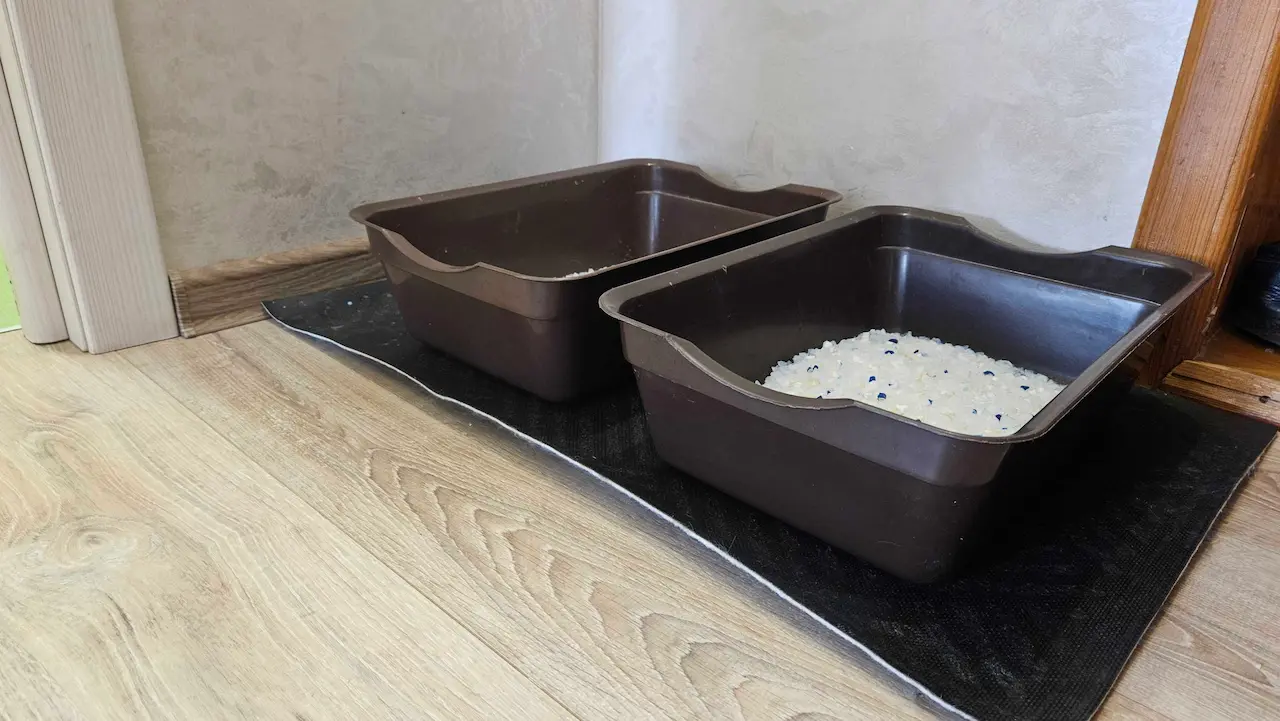
You can also try removing the lid of the cat litter box (if there is one) or changing the type of litter you use to encourage your cat to use their litter box still.
Why Do Cats Mark?

While some cats squat and urinate on bare floors, carpet, furniture, and other horizontal surfaces, others will spray urine on vertical surfaces around the house.
“Unsterilized cats spray urine to mark their territory and cats spray urine to let cats know they are ready to mate,” veterinarians say.
To avoid this behavior, it is recommended that cats be spayed when they reach 6 months of age.
Although cats often mark specifically because of hormones, there are other reasons for this. They may mark due to stress, anxiety, or frustration with their lifestyle as:
- restrictive diets,
- lack of playing time,
- territorial disputes with other cats.
If your cat is tagging because of disputes with other cats in the house or the neighborhood, you need to try to resolve the problem
First, be sure to separate the feuding cats in your household. And then leisurely reintroduce them, using treats to encourage their peaceful behavior.
We also have a great separate guide on how to properly introduce cats.
If your cat is marking due to stress or anxiety, discuss these problems with your veterinarian. Try to develop a solution to minimize your animal’s stress.
We realize that every family has their worries and often we don’t have time to worry. However, in all likelihood, the situation will not resolve independently. And it will still need to be addressed.
Clean urine stains before they start to smell worse
The smell of cat urine is known to get stronger and stronger over time.
If you miss and don’t clean up such an entry right away, that “cat odor” is sure to come back to haunt you later.
“When it comes to cleaning up cat urine, many owners make the same mistake of not cleaning it up fast enough,” reminded one cat behaviorist.
Also, the cat will remember the spot and of course, be sure to go to the bathroom there more than once.
Products for Cleaning Cat Urine Odor

It has been proven that certain products can actually help neutralize the smell of cat urine, including vinegar, baking soda, or enzymatic cleaners.
Here are a few options to help you get rid of cat or cat urine odor.
Baking soda, vinegar, manganese
Vinegar, despite being pretty smelly on its own, works great at removing stubborn urine odor.
After all, vinegar is an acid that neutralizes the alkaline salts that form in dried urine stains.
A solution of one part water and one part vinegar can be used to clean walls and floors.
From our experience, the vinegar odor usually disappears after a few days, taking the urine odor with it.
Enzyme based cleaners
To remove odor from carpets, couch cushions, mattresses, and bedding, you can try an enzyme-based cleaner.
The enzymes in such cleaners break down the acid in cat urine while helping to get rid of the odor.
Natural enzymes and beneficial bacteria are known to help get rid of harmful odor-causing bacteria.
When cleaning any surface, it’s important to ensure that not only you, but your cat, doesn’t smell urine.
“If a cat smells previous urine (his own or another animal’s), the area is likely to be used as a toilet again,” veterinarians say.
Avoid products containing ammonia
Most importantly, avoid cleaning products that contain ammonia.
As mentioned earlier, ammonia is a component of cat urine. So, if cats smell it, they are more likely to go to the same spot again.
Also, ammonia and other chemical cleaners can reverse the stain you want to get out.
How to Get the Smell of Cat Urine Out of a Carpet?

To eliminate the smell of cat urine from your carpeted surface, the following steps are recommended.
1. Blot the stain to absorb the urine
It is advisable to find the stain as soon as possible and then blot it with a paper towel, tissue, or toilet paper. We, for example, often use the cheapest gray toilet paper. This way you will get rid of the bulk of the liquid.
2. Rinse and vacuum the “contaminated area”
Then rinse the area with clean water and remove the liquid with a detergent/dry vacuum cleaner (if available).
At the same time, it is not recommended to use steam cleaners, as the high temperature can fix the stain on the contrary.
3. Soak the stain in an enzyme cleaner
While enzyme cleaners are often sold in aerosol packaging, spraying a light coat on the stain will do little good. It makes sense to remove the atomizer and pour the contents of the tube liberally over the stain.
4. Allow the stain to stand before blotting with a clean cloth
Leave the cleaner on for 10-15 minutes and then blot it with wipes as hard as you can.
5. Prevent reuse of the “crime scene”
To keep your cat from returning to that spot while you’re cleaning, put a piece of aluminum foil there and cover it with an upside-down laundry basket or any other object.
6. Reapply cleaner if necessary
You may have to reapply the cleaner and let it dry again if the stains are old or particularly smelly.
Removing cat urine odor from the floor
In unfortunate circumstances, urine can seep through the carpet onto your floor (laminate, parquet, etc.). This will create a stain and stench that cannot be removed with a carpet cleaner.
In such a case, you may even have to remove part of the floor together with the carpeting.
How to Remove Cat Urine Odor From Pillows?

Here are some simple steps you can take to remove cat urine odor from your pillow.
1. Soak the contaminated area in water
Moisten the affected area of the pillow with water. Blot up as much cat urine as possible with a rag or paper towel.
2. Soak the area with an enzymatic cleaner
Then gently apply the enzyme cleaner to the soiled part of the pillow and around it.
3. Allow the cleaner to absorb slightly
Leave the cushion for 15 minutes, then squeeze out as much excess enzyme cleaner as possible before blotting with a cloth.
4. Allow the cushion to dry
If possible, leave the pillow outside as long as possible while it dries. Since they can take several days to dry, cover it with one layer of foil. And then another to deter the animal.
How to Get Cat Urine Odor Out of a Mattress?

Mattresses require almost the same process as pillows.
1. Soak the “affected” area in water
Moisten the affected area of the mattress with water. Blot up as much cat urine as possible with a cloth or rag.
2. Soak the spot with an enzyme cleaner
Then soak the mattress very slowly pouring the enzyme cleaner on and around the affected area.
3. Let it stand before blotting it with a cloth
Leave the enzyme cleaner on for 15 minutes and then blot it off. Place several layers of any clean cloth on the mattress and then make the bed.
4. Allow the mattress to dry
Change the fabric every day until the mattress is completely dry. To prevent the cat from urinating on the old spot while the mattress dries, cover the bed with a large plastic sheet, plastic sheeting, or tarp.
If the incidents continue, it may make sense to purchase a waterproof mattress cover.
How to Remove Cat Urine Odor From Bedding and Clothing?

One important rule when working with bedding and clothing: NEVER use bleach – when mixed with ammonia and cat urine, it can release harmful gases.
1. Wash the stain with cool water
If your linens and clothes are machine washable, first rinse the stain with cool water in the sink.
2. Washing with detergent and baking soda or apple cider vinegar
Add things to the washing machine with detergent and a cup of baking soda OR a quarter cup of apple cider vinegar.
3. Add things to the washing machine with detergent and a cup of baking soda OR a quarter cup of apple cider vinegar.
If you still smell urine after completing the cycle, add enzyme cleaner to the load (following the instructions on the package) and repeat the cycle.
4. Drying in fresh air after washing
Always air-dry your bedding, as the heat of the dryer can lock in odor before it’s completely gone.
5. Wash again (if necessary)
You may have to re-wash one or more times until the odor is completely gone.
Get the cat away from that particular spot.
Once you have finally cleaned up the area you need to urgently prevent the incidents from happening again.
This can be done by changing the importance of this area to your pet.
In other words, since cats prefer to eat and defecate in different places, you can try:
- put bowls and treats exactly where they were previously soiled;
- to play with the cat in this place;
- to leave the toys there.
List Cat Cleaners and Odor Eliminators From Murmeo

You can of course search for such products on the internet yourself.
However, to save you time we offer a ready-made list of odor eliminators and neutralizers for cats. It is based on the maximum number of positive customer reviews.

Nature’s Miracle Stain and Odoor Remover — Cat stain and odor remover spray (946 ml)

Thornell Cat Odor-Off — Cat scent neutralizer (474 ml)

Pet’s Lab Stop-smell — Odor neutralizing spray (150 ml)

Thornell L.O.E — Pet odor neutralizer for laundry (946 ml)
General Tips on How to Remove the Odor of Cat Urine
Hopefully, you now know a lot more about how you can get rid of cat or cat urine odor in your home.
And to summarize, let’s fix it with some general recommendations.
- Find out the source of the foul odor and locate the exact spot where your pet went to the bathroom.
- Take paper towels, napkins or old rags and a container of water.
- Using paper towels, gently blot the urine to collect as much moisture from the surface as possible. Do not rub the stain vigorously or wash with warm water.
- If you have a washable vacuum cleaner – use it on cold mode or wash the area by hand.
- Neutralize the odor with traditional remedies or specialized eliminators.
- Limit your pet’s access to the area.
That’s all for today 😸😸😸
Be sure to leave your ideas and observations in the comments – we will be useful to our entire cat community.
The article partially uses the materials of the resource PetMD.
Murmeo link to the article: https://murmeo.com/kak-izbavitsya-ot-zapaha-mochi-kota/


