

How to choose a scratching post – this question came up all of a sudden after our old one had worn out.
It would seem like a simple thing to do – find any scratching post on the Internet in two clicks and place an order.
However, as they say, “the devil is in the details”.
We made conclusions from our old scratchers and determined for ourselves the main criteria for the choice. And it turned out that finding the right one for us is not so easy.
What is the best scratching post for a cat – in this article, we will share our experiences, observations, and conclusions. Again, our assumptions are grounded in years of watching our pets.
There will be a lot of text and images because we tried to cover all possible points – we hope you have no questions after the article.
Since we have 3 cats and the same number of different scratching devices, we’ll try to help you make the right choice – what type of scratching post is best for cats.
There will be a long read because we tried to describe all the aspects related to scratching posts.
Let’s go!
- Why Do Cats Need a Scratching Post?
- What Types of Scratchers Are There?
- What Material Are Cat Scratchers Made of?
- Manufacturers of Scratching Posts
- How Do You Pick a Scratching Post (Options List)?
- 1. Safety of the Scratching Post
- 2. How to Choose the Type of Scratching Post for Your Cat?
- 3. What Kind of Wrap for a Scratching Post is Better?
- 4. What Should Be the Height of a Scratching Post for an Adult Cat?
- 5. What Should Be the Functionality of Scratching Towers?
- 6. What is the Longevity of the Scratchers?
- 7. The Ease of Cleaning Factor of the Scratcher
- 8. Design and Appearance of the Scratcher
- What Kind of Scratching Post Do We Use?
- How to Train a Cat to the Scratcher?
- Checklist for Choosing a Scratching Post (Memo)
- How to Choose a Scratching Post (Infographics)?
- Bottom Line on The Best Choice of Scratchers
- Frequently Asked Questions
Why Do Cats Need a Scratching Post?
To begin with, claw sharpening is a normal behavior in cats and a serious physiological need. It is not worth ignoring.

The main reason for scratching is the need to remove old scales on the claw. When sharpening claws against rough surfaces, the cat removes dead claw particles, making a place for young claws (You can see claw particles in the photo).
In addition, this procedure prevents claws from growing into the cat’s pads.
Another reason for cat scratching is also voiced – territory marking. Cats can mark their territory this way and feel closer to their natural environment.
Recall that this habit is not alien to other big cats – tigers, lions, and panthers.
Each animal is unique in its way, so it may have its preference for things that can be scratched. Some will nestle on a couch or chair, and some will like the corner of a wall with wallpaper.
If you don’t already have a scratching post, believe us, you will soon notice the lack of this interior item! Your home items will start to wear out miraculously and very quickly. You should not delay in acquiring it.
And we know how to choose the right scratching post – and we’ll help you with this.
And so, let’s define the terms.
A scratching post, scratcher, claw sharpener – all imply some kind of construction specially designed for sharpening claws.
There can be many variations: from simple columns and floor scratchers to complex tiered complexes. We will talk about all of these variations a little later.
What Types of Scratchers Are There?
Let’s start with the most basic parameter as the type of scratching post – their availability is quite diverse.
Scratching Posts (column)
In our opinion, this is the most common scratcher because of its simplicity, practicality, and affordability. Cats like it because it appears to resemble a tree.
The base can be made of chipboard, fiberboard, or natural wood. Rope, sisal, or jute is used as a covering for the pole.
There are variations in the form of a simple column, as well as with a cot on top.


Horizontal Scratchers
The name speaks for itself – these scratching pads are placed on the floor in any convenient place in your home. There can be plenty of variations: sisal roebuck, cloth upholstered board, springboards, and others.
Considered to be a great solution for cats who like to paw at carpets. One of our cats likes exactly horizontal scratching.


Flat Scratchers
Bright representatives of this type are shaped, cardboard scratchers. Such scratchers also serve as a sleeping place or a cot.
Such cardboard beds fit very well into the interior of the apartment because they have a good design.
But don’t be fooled: it is no substitute for a full-fledged soft couch. Also, remember that not all cats like to sharpen their claws horizontally.


Vertical Scratchers
Quite a popular type of scratching post because of its compactness. There are two variations: wall-mounted on one plane and angular (in two planes).
Such scratchers are made in the form of a rectangular sheet or board wrapped in sisal, jute, or fur. They are usually mounted on the wall or furniture using hinges and screws.
When installing such type of scratcher it is important to consider the size of your pet – the larger the pet, the higher you need to mount it.
An important rule: the cat must be able to stretch to its full height.


Cat Scratchers Shelves
That’s an unusual solution for cats who love heights (though, they all do). Such shelves especially make sense for households that also have other pets, such as dogs.
Your pet will feel safe looking at everyone from above.


Scratching Towers
And there is no limit to perfection – everything will be based only on your budget. The choice and variety of complexes are quite large: from simple variations to 3-meter structures of several square meters.
The main thing is not to forget what you buy it for – that is, the availability of comfortable places for sharpening claws is a must.
By the way, a scratching tower is a good place for your pet to exercise, which can prolong your cat’s life.


Scratching Toys
Another type of scratcher is all kinds of small toys. Accordingly, they can be balls made of cotton, balls, shaped plastic, or wooden planks. The main thing is that they should have a coating on which the claws can be sharpened.


Other Interior Items With Special Coatings
And rounding out our list are the usual interior items, but specially adapted to the needs of our feline family members.
Such examples can be poufs or table legs covered with sisal rope or even entire doorways upholstered with special fabric. Thus, any variations on the theme “how to save furniture and not to offend the kitten” are welcome.


That seems to be the whole list – if we missed anything, correct us in the comments.
By the way, recently there have been quite beautiful designs that can fit perfectly into the interior of a modern apartment or house.
What Material Are Cat Scratchers Made of?
Jute
The undisputed leader in the quality of upholstery used is jute.
Jute is a natural textile fiber made from plants of the same name. These fibers are mainly used to make sacks, ropes, and our scratchers.

Jute is usually:
- Gray or yellow-brown color
- Soft
- No protruding fibers
- Has a low cost
Sisal
The second popular coating is sisal.
It is a natural, coarse fiber derived from the leaves of a plant of the genus Agave. Sometimes the plant itself is also called sisal. The fibers of this plant are extracted from fresh leaves, usually without special treatment.
The largest producers of sisal are Brazil, Tanzania, and Kenya.

The distinctive properties of sisal are:
- Light sand color
- Tougher in structure
- Longer life span
- 30-50% more expensive than jute
Carpet, Velour, Plush, Textile, and Other Fabrics
These materials are used only as auxiliary padding and are not particularly designed for claw sharpening.
Cardboard
Cardboard is a relatively new material that has come to be used in the production of scratchers. It is made from cellulose and then pressed in a special way to obtain the desired shape of the sheet.

To join the cardboard should use the safest glue possible on water and starch – hopefully, it is.
During scratching, the claws of the pet do not get stuck and do not cling to the surface. Unlike sisal fiber, which makes this scratching post as safe as possible for the pet.
Manufacturers of Scratching Posts
Brand-name manufacturers of scratching posts
Global brands that are involved in the production of pet products.
The obvious advantages are, of course, the quality of the product, but you have to pay extra for that.
Local producers
In this category we include regional and domestic manufacturers of scratchers – there is quite a decent number.
Private production
Entrepreneurs who make scratchers order and have very small production facilities.
Remember, you can buy a scratching post from any of the above categories. Most items are made according to certain standard layouts and drawings – if it comes to simple things. Theoretically, they will be difficult to spoil, and defective or substandard items can fall even with the most famous brands.
How Do You Pick a Scratching Post (Options List)?
It’s time to move on to the most important question, “How to choose the right scratching post?” and what criteria should it meet?
We will list the criteria from the most important to those that can only be recommendatory.
Our observations are based on medium-sized cats weighing no more than 5 kg. You will need to adjust our recommendations slightly according to the size of your pet, but it is better to take a margin.
Opinion! We are guided solely by personal observations of our pets over many years. Our point of view may differ from yours or be generally accepted, but we are always willing to listen to any adequate and objective points of view.
1. Safety of the Scratching Post
The criterion of safety is definitely at the top of our list. After all, nothing is more important than the health and well-being of your pet.
There have been cases where scratching posts have been overturned or fallen. Thus severely traumatizing the animals, up to and including spinal fractures or fatalities.
We have witnessed when our scratching post at one point was overturned by our cats and fell with a bang – thankfully no one was hurt. This is what a fallen scratching post looks like!
A temporary solution was to reinforce the support area of the scratching post by installing a 6-liter can of water. It didn’t fit much into the design, but it worked as a temporary solution.

Safety for the scratching post (column)
You should pay attention to the size of the support area for this type of scratching post, as well as its weight – it should be at least 35-40 cm with a post length of 70 cm. The reason is very simple: they tend to turn over, especially if they stand in your NOT corner place.
Extreme care if you have a post-type scratching post with a lie-flat on top (like ours). This is the type of scratching post that has a good chance of turning over.
With the post height of 70 cm and the support area width of 45×45 cm – our cats managed to turn it upside down. It was decided to increase the support area to 50×50 cm. It kind of helped!
Opinion! If your post scratcher has a cot on top, its support area should be at least 50×50 cm (for a standard base of chipboard or fiberboard).
Safety for the scratching tower
Large and cumbersome complexes in the fall will not leave a chance for your pet – you should be extremely careful with their installation.

In most cases, they need to be attached to the walls with special fasteners – a couple of these corner fasteners will be enough to sleep well.
Again, we are talking about a height of more than 1.5 m if the set is not installed in the corner of the room.
The control point is the base area of the structure. It must be at least 50×50 cm for a height of 1.5 m. The base must-have supports on all 4 points of the foundation (see image).
Observation: Why do we distinguish between these installation methods: in the corner or not? If the structure is just along the wall, then cats tend to accelerate along the wall, jump on the scratching post and then push away from it.
At the moment of repulsion, according to all the laws of physics, your design can be on the floor!
Safety for scratchers shelves
No comment is probably needed here, but you have to consider when mounting it on the wall:
- The weight of the cat, and if you have two or more, at least both of them. We often have them both hanging out in the same place.
- The weight of the scratcher itself. As a result, the mount should be able to support at least 15 kg (if the cats weigh up to 5 kg), and preferably up to 20 kg.
If our advice helps to save the health or life of at least one of our pets – let’s consider that we have not wasted time writing this article.
2. How to Choose the Type of Scratching Post for Your Cat?
Start with the simplest type, the scratching post (column). There is a decent chance it will fit most of our kitties.
However, you should observe the pets – if they prefer to claw in a horizontal position, then you should buy a horizontal scratcher.
A little later, when you understand all the preferences of your pet, you can buy something more expensive or the whole scratching tower.
We use a cardboard scratching post as a floor scratcher.
3. What Kind of Wrap for a Scratching Post is Better?
Well, the question is rhetorical here.
Jute is considered a softer wrap, but it is not as durable as sisal. Also, jute will be a little cheaper and most manufacturers work with this material.
Sisal, on the other hand, is more durable, and we’re honestly thinking about trying this wrap.
It should be remembered that both materials are considered safe for our animals. We even sometimes notice our cats chewing and tasting the jute fibers.
By the way, here’s what the jute wrap looked like after a year under 2-cat operating conditions.


4. What Should Be the Height of a Scratching Post for an Adult Cat?
We have our particular observations about the correct height of the scratching post.

Your cat should be able to stretch to his full height to sharpen their claws – for them, it is also a kind of gymnastics.
The conclusion is: the height of the scratching post (for the vertical version) for an adult cat should not be less than the height of your pet in the “stretched” state.
As you can see in the picture, our cat reaches about 50 cm and that’s without extending her paws to the top.
It makes sense to focus on the height of the pole at least 70 cm for a medium-sized animal. Of course, if you have a Maine Coon (one of the biggest cat breeds), you should not buy a post less than 1 meter. Otherwise, there’s a chance that your pet will be attached to the clawing somewhere else more conveniently.
5. What Should Be the Functionality of Scratching Towers?
We also have a very important note about scratching towers. Very often they may NOT be functional – accordingly, your pet will not use them and your budget will be wasted. Perhaps the manufacturers don’t understand some of the nuances and preferences of our pets.
We will try to tell you what you need to look at when choosing a large scratching tower. Be sure to pay attention to the following design elements.
1. Construction stability
Must have. Stability of the scratching tower installation and the possibility of additional fastening (we discussed this in the section on safety).
2. Height of poles (pipes) available in the structure
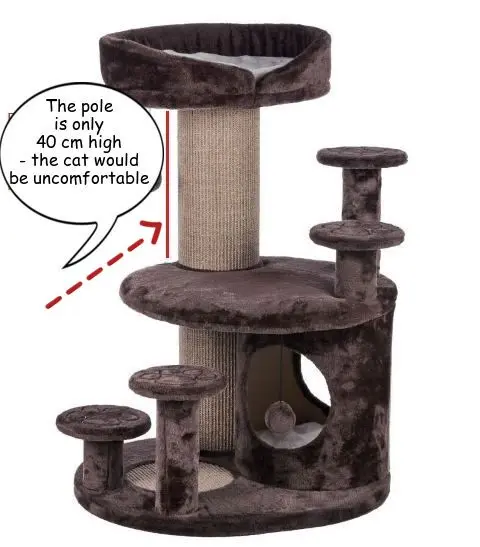
Recall that at least one tube should be high enough for the pet to stretch and claw normally (at least 70 cm for the average animal).
In the above image, you can see a potentially uncomfortable post for the dragging.
It should be noted that often towers contain 3 or 4 short bases uncomfortable for our pets – it is very likely that they will be ignored.
3. Ability to reroll and renovate
It is certain that after a certain time, your pet will “wear out” the home structure a bit and you will need to think about restoring it.
If your scratching tower is not collapsible, there is no access to the elements, or it requires a lot of effort to disassemble, it can be a bit of a problem.
Try to choose as simple designs as possible – trust us, the cats won’t care, and it will be easier for you to maintain it.
4. Cradles on a scratcher
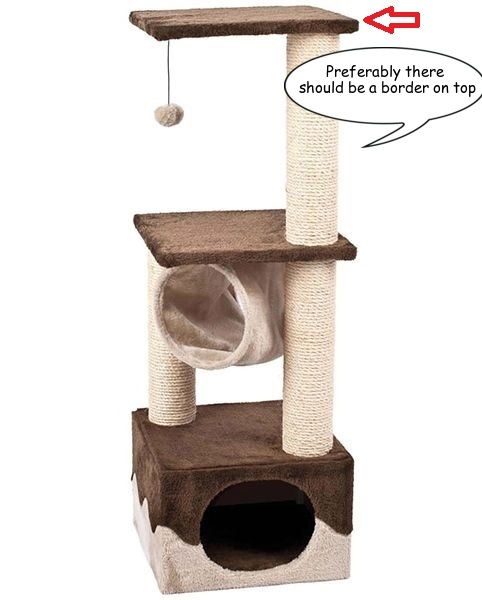
We have noticed that cats will sleep or lie down only if the space is limited.
That is, if the element of the scratching tower is just a shelf without sides, the cats will NOT lie or sleep there.
At most, they will just sit there and observe the situation.
So, if your scratching tower is also supposed to be a sleeping place (according to the number of your cats), then be sure to pay attention to this nuance, so that all fit.
5. Not recommended design elements
The presence of the cabin from below is not recommended. It is proven that cats feel safer when they are on top and can assess the situation from above. So, that house on the bottom will not be appreciated by your cat and will only interest her for the first few days.
And then this part of the structure will become a regular “dust collector” – your cat will ignore this place.
Any enclosed spaces are not recommended. Even if the enclosed house is high up, there’s a good chance the cat won’t be interested in it anyway. Again, the answer lies in the fact that cats like to see and observe the situation. But a confined space doesn’t give her that opportunity.
Ladders and similar items are not recommended. Cats are not people, they will not walk on stairs. Their main way is to jump on the required place and settle down there. That’s it, end of the story…
🐱 Ideal for the functionality of a scratching tower (list):
- the construction is stable;
- the height of 1.5 – 2 meters;
- the cat can completely reach out and scratch its claws on at least one post;
- there are one or more open seats with boards;
- easy rewinding and restoration.
6. What is the Longevity of the Scratchers?
This factor isn’t that important for cats, but it can be important for your budget. We did want to mention it.
Horizontal cardboard scratcher
According to the manufacturer’s claims, the cardboard scratcher should last about a year. We take into account the use of only one animal.
We have three animals, but in fact, the cardboard scratcher liked only one cat – the rest of them plus or minus ignored it. That’s why we consider the manufacturer’s specified operating time to apply to our situation.
So, the cardboard “bed” feels very good after a year of use. The only thing we would like to point out is:
- We turned it on its other side after about 7-8 months (one side was already pretty badly emaciated);
- Of course, there is a little bit of cardboard small debris in the process of scratching.
But most importantly, we would like to say the cat likes this “device” and she sleeps on it sometimes.
All in all, we hope that the cardboard scratcher will serve for 1.5 years. Which is pretty good considering the price of USD 30.
You probably should not take the cheapest options – manufacturers can save on the quality of cardboard, glue, or body plywood.
Especially the glue, there is a decent amount of it to assemble this construction into one whole. So do not save much to choose the cheapest option.
Opinion! You can safely take the cardboard horizontal scratching post at least for introductory purposes. In addition, it will fit into your interior decently.

What is the longevity of jute and sisal scratchers?
We only have observations on jute padding. At 2 “tails” our scratching post (column) worked for about 1.5 years – and so plus or minus two times. So the statistics should be more or less correct. After that time, we did a rewind for our scratching post.
There is an assumption that sisal wrapping could last a little longer, but this fact has not yet been proven by us. And the service life of jute is quite satisfactory for us.
7. The Ease of Cleaning Factor of the Scratcher
We believe that this factor also has some weight in choosing a scratching post. A scratching post collects a decent amount of hair, claws, and dust. Naturally, the presence of hard-to-reach places, like cabins, will make the cleaning process much more difficult.
8. Design and Appearance of the Scratcher
This point is in last place, but perhaps someone may think differently.
Not to be offensive to some manufacturers, but sometimes their products look so ridiculous in terms of practicality and design that you want to “hug and cry” this poor scratching post.

Recently, though, really interesting solutions that combine safety, reliability, and practicality have begun to appear (see image).
For example, variations for posts, the base of which is made of wood instead of standard chipboard. In this case, all elements can be connected without the use of nails and screws – aesthetically, it looks very good.
Hopefully, we’ll get to those options sometimes too…
What Kind of Scratching Post Do We Use?
We would like to mention the scratchers we use. There are three different scratching posts of various formats.
Cardboard scratching post. This is a medium-quality floor scratcher – not the most expensive, but not cheap either.
In 80-90% of cases, only one cat uses this scratcher – she prefers to scratch horizontally. The rest of our animals ignored it for some reason.
In terms of usage time, we can safely say that it will last more than 1 year. We turned this cardboard scratching post to the other side after about 8-9 months of use and continued to operate it.
A scratching post (column). At one time (5 years ago) we ordered a scratching post with the following parameters:
- height – 1 meter;
- post height – 70 cm;
- The diameter of the pole – is 10 cm (quite wide and cats like it);
- foot size – 45 x 45 cm;
- wrapping is jute;
- On top, there is a sleeping place with a rim upholstered with artificial fur.
The only thing that was done was a jute re-stretch, about every 1.5 years. It turned out to be a very good choice. The cats love it and also use it as a sleeping place.
So, we advise sticking to these parameters.
Scratching Tower. The most recent acquisition was a 160 cm scratching tower.
What structural elements does it have:
- support size is 50 x 50 cm;
- the diameter of the columns is 12 cm;
- The height of the main post – is 1m (it is convenient to scratch and cats climb like a tree);
- wrapping is jute;
- On top, there is a sleeping place with a board upholstered with textiles.
Although the tower is a bit high, it turned out to be quite stable because it has four places of support. But just in case there are 2 sets of corners to screw it to the wall.
The impression of this scratching tower is very positive (not for nothing so carefully chosen) – the cats climb on it, hold and sleep.


How to Train a Cat to the Scratcher?
We believe that we have decided on a scratcher – the only thing left is to train the cat to the scratching post.
One thing is certain, if this is the first scratching post for your cat, she may be suspicious of it.
It is advisable to place the scratching post near their favorite sleeping place because cats like to stretch after sleeping. It is also recommended to keep the scratching post in places where your animals spend most of their time.
A scratching post that is in a hard-to-reach location will probably not be used for its intended purpose.
You can use several tricks to train your cat to the scratching post:
- rub catnip (either dried or extract will do) on the scratching post;
- play with a laser or teaser near or right on the post for the cat to climb on;
- you can put a small piece of a treat to attract the pet;
- It is not necessary to force the cat on the scratching post – the animal may be frightened and not come near it anymore.
For other tricks and nuances about adapting a cat, read the detailed guide.
Checklist for Choosing a Scratching Post (Memo)
1. Safety
For scratching posts (columns):
- Footing area: 35-40 cm (or more) with a pole length of 70 cm or more.
- Footing area: 45 cm (or more) with the length of the post from 70 cm and the presence of a laying cot.
- The column must be stable.
For scratching towers:
- Base area: at least 50×50 cm for a height of about 1.5 m.
- Supports should be on all 4 corners.
- The tower must be sustainable.
- If necessary, you must additionally fix it to the wall with special fasteners.
- When installed along the wall (not angled) – stability is reduced.
For the scratchers (shelves)
- Should hold at least 15 kg (if the weight of cats is up to 5 kg), or better up to 20 kg.
2. Choosing the type of scratching post
- Horizontal – for animals that prefer to scratch horizontally (carpet, couch).
- All others are for all preferences.
3. Selecting the wrapper
- Jute is a softer wrap, but not as durable as sisal. Cheap.
- Sisal is more durable and slightly more expensive.
- There is no difference in function.
4. Height of the scratching post (column)
- At least 70 cm for an average cat.
- Cot – if available, preferably with sides.
5. The functionality of the scratching towers
- The possibility of additional fastening.
- The height of at least one post is at least 70 cm.
- Possibility of rewinding and restoration.
- The presence of a cabin at the bottom is NOT recommended.
- Any enclosed spaces are NOT recommended.
- Ladders and similar elements are NOT required (only a structural reinforcement element).
- Cots – preferably with sides.
6. Longevity of the scratching posts
- Cardboard scratchers – 1-1.5 years.
- Jute wrapping – 1-1.5 years.
- Sisal wrapping – no expertise, but probably a longer life than jute.
7. Ease of cleaning
- Lack of hard-to-reach places, like cabins.
8. Design and appearance
- It’s a matter of taste and your budget.
* Conclusions are based solely on our years of experience and observation of our pets. As well as feedback from numerous friends and acquaintances.
How to Choose a Scratching Post (Infographics)?

Bottom Line on The Best Choice of Scratchers
In conclusion, we would like to point out that choosing a scratching post is up to you. Try to take it more or less seriously.
The best scratching post is undoubtedly the one that will please your pet. We hope we have made it a little clearer how to pick a scratching post.
What are your thoughts on this? What kind of scratching post do you use? It would be interesting to hear your opinion – write in the comments.
Frequently Asked Questions
Murmeo link to the article: https://murmeo.com/en/how-to-choose-the-right-scratching-post-for-cats/


